Tulip Flower Outline: A Designer’s Real-World Stitch Test
First Impressions: Light, Lyrical, and Surprisingly Versatile
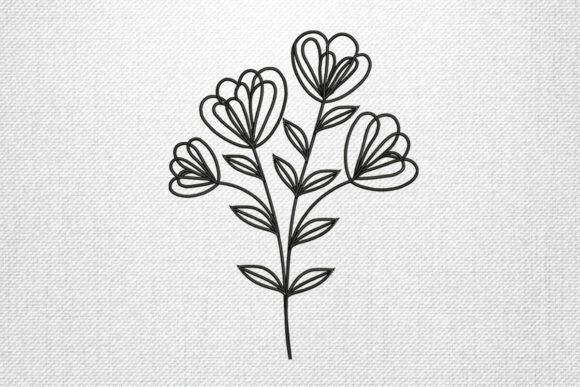
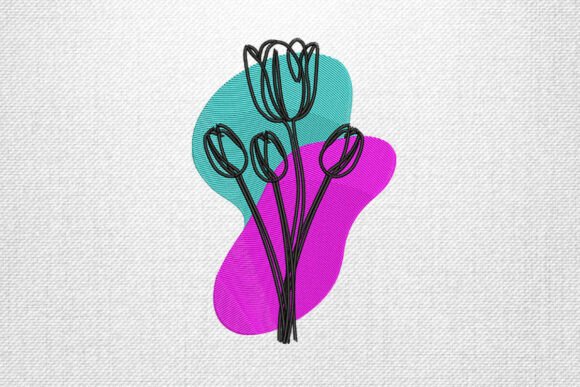
When I opened Tulip Flower Outline for the first time, I didn’t see just another floral motif—I saw a quiet confidence in its line work. It’s not fussy or over-rendered. No heavy satin stitch petals, no dense fill areas begging for stabilizer heroics. Just clean, purposeful curves—three soft tulip blooms arranged with gentle asymmetry, connected by a subtle vine that breathes rather than crowds. The mood is instantly recognizable: whimsical but grounded, playful without tipping into childishness. That matters—especially when you’re stitching for grown-up tote bags, boutique aprons, or nursery pillows where charm needs to wear well over time.
A Tote Bag Trial: Where Personality Meets Practicality
Last week, I used Tulip Flower Outline on a natural canvas tote for a local florist’s pop-up shop. Cotton canvas is forgiving—but only if the design respects its texture. This outline held up beautifully: the running-stitch-like flow (though technically a single-layer machine embroidery design) traced cleanly across the weave without snagging or skipping. No ghosting on the reverse. No need for tear-away *and* cut-away stabilizer—just medium-weight tear-away did the job. What surprised me was how customers responded: several paused mid-shop to ask, “Is that hand-drawn?” That’s the power of a well-balanced outline—it reads as intentional, human-made, even when stitched by machine. For Etsy sellers and small shop owners, that perceived craftsmanship directly lifts perceived value—and trust.
Where It Shines (and Where It Asks for Attention)
Tulip Flower Outline thrives in contexts where subtlety supports story—not overshadows it:
- Custom apparel: On lightweight cotton tees and relaxed-fit sweatshirts, it lands softly—ideal for minimalist branding or personalized gifts where the recipient’s name or date stays the star.
- Baby embroidery: Perfect for onesies or burp cloths. Its open structure avoids stiff, bulky seams that irritate delicate skin.
- Kitchen & home textiles: Tea towels, pillow covers, and linen napkins benefit from its airy rhythm—no risk of muddying fabric drape with dense fills.
- Holiday or wedding embroidery: As a standalone accent on a linen sachet or embroidered coaster, it whispers elegance instead of shouting.
But—and this is critical—Tulip Flower Outline isn’t bulletproof everywhere. On stretchy knits (think baby bodysuits or performance fabrics), test thoroughly: slight puckering can happen near tight curves without proper stabilizer tension. On dark fabric, thread color contrast becomes non-negotiable—light ecru or soft grey thread may disappear unless you intentionally lean into tonal stitching. And on curved surfaces like caps? Reserve it for front panels only; the vine’s gentle arc won’t conform smoothly to crown curvature without digitizing adjustments.
Design Judgment: Beyond Aesthetics
As a designer who ships hundreds of embroidered patches and custom apparel pieces yearly, I assess more than prettiness. I ask: Does this support my brand voice? Will it scale across product types? Does it hold up after five washes—and does it look handmade *enough* to justify a premium?
Tulip Flower Outline checks those boxes thoughtfully. Its simplicity means it integrates cleanly into larger compositions—say, as a corner accent on a quilted pillow cover or paired with monogrammed initials on a holiday tea towel. It doesn’t compete; it complements. For craft businesses building cohesive collections, that consistency matters. And for digital product sellers, it’s a strong candidate for printable mockups: its clean lines translate crisply in grayscale previews, helping buyers visualize placement before purchase.
Practical Notes Every Embroiderer Should Run Through
Before committing to a full run—whether for client work, your Etsy shop, or a craft fair batch—do these six things:
- Test on scrap fabric that matches your final substrate: same weight, same stretch, same finish.
- Check thread color contrast on both light and dark backgrounds—not just on screen. A warm ivory thread sings on oatmeal linen but fades on charcoal.
- Review stitch density visually in your embroidery software—if the file includes any fill elements (even tiny ones), confirm they’re sparse and low-density.
- Confirm hoop size compatibility. While outlines tend to be compact, verify it fits comfortably within your most-used hoop—especially if you embroider on-the-go with smaller machines.
- Inspect fine corners and vine junctions at 200% zoom. Are stitch jumps minimized? Is there any unnecessary overlap that could cause thread buildup?
- Verify licensing terms before selling finished products or bundling the file in digital embroidery packs. “Machine embroidery design” implies commercial use may be permitted—but always double-check.
Final Thought: Charm That Earns Its Place
Tulip Flower Outline isn’t flashy. It won’t dominate a tradeshow booth or stop scrollers mid-feed. But that’s precisely why it works so well in real life. It’s the quiet detail that makes a handmade product feel considered—the kind of embroidery that earns compliments weeks after gifting because it keeps revealing itself: in the curve of a petal, the pause between blooms, the way it moves *with* the fabric instead of sitting on top of it. For designers, crafters, and creative entrepreneurs building meaningful, repeatable work—this isn’t just another Outline Flowers file. It’s a reliable, graceful tool. Use it where lightness matters. Let it breathe. And watch how often people ask, “Where did you find that?”